
Introduction
Cloud computing revolutionized how businesses manage data, offering scalability, flexibility, and cost efficiency. But as digital services expand, especially with IoT, autonomous vehicles, and real-time analytics, edge computing has emerged as a powerful alternative. This sparks a critical debate: will edge computing replace the cloud, or will the two coexist?
In 2026, the answer appears clear—neither technology will dominate alone. Instead, we’re heading toward a hybrid future, where cloud and edge complement one another.
The Strengths of Cloud Computing
The cloud has been the backbone of digital transformation for over a decade. Its key strengths include:
-
Scalability: Businesses can scale resources on demand without massive infrastructure investments.
-
Cost Efficiency: Pay-as-you-go models reduce upfront capital costs.
-
Collaboration: Cloud enables seamless collaboration across geographies.
-
Big Data Processing: Centralized servers handle massive datasets and AI model training effectively.
From startups to Fortune 500 companies, the cloud remains indispensable for enterprise operations.
The Rise of Edge Computing
Edge computing shifts data processing closer to where it’s generated—on IoT devices, sensors, or local servers. This reduces latency and bandwidth needs, enabling real-time decision-making.
Examples include:
-
Autonomous vehicles process road data instantly.
-
Smart factories using AI at the edge for quality control.
-
Healthcare devices monitor patients and alert doctors in real time.
By processing locally, edge computing improves speed, reliability, and efficiency.
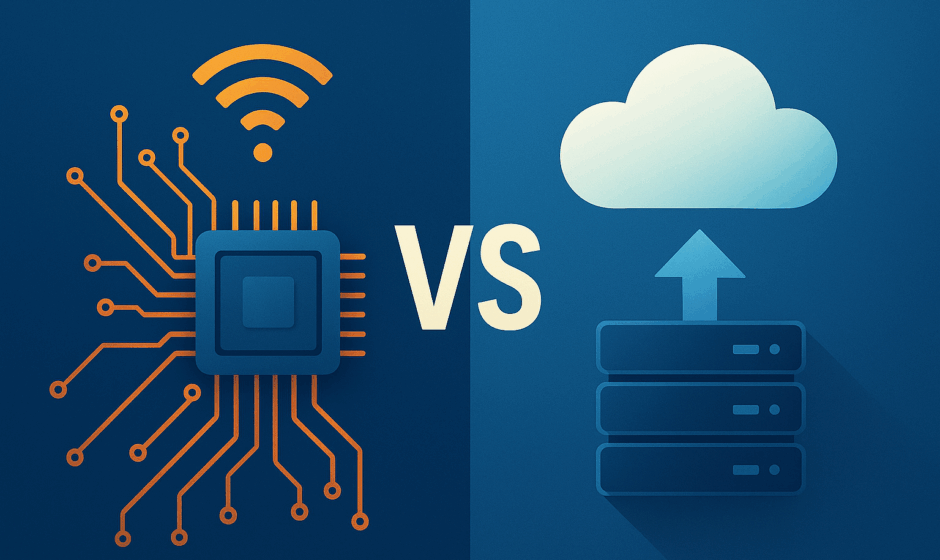
Cloud vs Edge: Key Differences
-
Latency: Cloud processing can cause delays due to data travel; edge delivers near-instant results.
-
Connectivity: Cloud requires strong internet access, while edge can operate offline or with weak connections.
-
Scalability: Cloud is better for handling global workloads; edge is optimized for localized needs.
-
Security: Edge reduces centralized attack risks but increases the number of vulnerable endpoints.
Why It’s Not a Zero-Sum Game
While edge excels in real-time processing, it cannot replace the cloud’s storage and computational power. Similarly, the cloud cannot always deliver the low latency needed for emerging use cases.
In practice, most companies are adopting hybrid models, where edge devices handle immediate data processing, and the cloud stores, analyzes, and distributes insights at scale.
The future isn’t edge or cloud—it’s both. In 2026, smart businesses are blending real-time edge performance with the scale and power of the cloud, creating agile, resilient systems built for the next wave of innovation.
Industry Adoption Trends
-
Manufacturing: Edge computing powers predictive maintenance and robotics, while the cloud supports global supply chain management.
-
Retail: Stores use edge AI for personalized customer experiences, with the cloud managing loyalty programs and analytics.
-
Telecommunications: 5G networks depend on the edge for ultra-low latency services, backed by cloud infrastructure.
-
Healthcare: Patient monitoring devices use the edge for real-time alerts, while the cloud aggregates data for research.
Challenges of Edge Adoption
-
Security Risks: More endpoints mean more vulnerabilities.
-
Integration Complexity: Synchronizing edge and cloud systems can be difficult.
-
Costs: Setting up edge infrastructure requires significant investment.
-
Standards: Lack of global standards slows widespread adoption.
Despite these challenges, edge continues to grow, supported by the rollout of 5G networks and IoT proliferation.
Conclusion
The debate over edge vs cloud isn’t about competition but collaboration. The future will be defined by systems that harness the strengths of both: edge for real-time, local processing and cloud for scale, storage, and global insights.
In 2026 and beyond, businesses that adopt this hybrid approach will gain a decisive edge—pun intended—over those that rely on one model alone.