
Strategy is often mistaken for planning. It is not.
Planning is about allocating resources. Strategy is about making choices—deliberate, often uncomfortable choices—about where to compete and how to win. Yet, in boardrooms and leadership teams across industries, strategy frequently devolves into slide decks, jargon, and frameworks applied mechanically rather than thoughtfully.
Business strategy frameworks were never meant to be rigid templates. They are thinking tools—designed to simplify complexity, challenge assumptions, and enable better decision-making. The problem is not the frameworks themselves. It is how leaders use them.
The CEOs who outperform their peers do not rely on a single framework. They synthesize multiple perspectives, adapt them to context, and most importantly, act decisively on the insights they generate.
This article takes a critical look at the most widely used business strategy frameworks—not as academic models, but as practical tools for leadership in an increasingly complex world.
Why This Topic Matters Today
The strategic environment has fundamentally changed.
- According to BCG, over 90% of companies fail to achieve sustained profitable growth over a decade
- A McKinsey study found that only 8% of companies effectively execute their strategies
- Meanwhile, digital disruption has shortened the average lifespan of companies on the S&P 500 from 61 years in 1958 to less than 20 years today
The implication is stark: strategy failure is not the exception—it is the norm.
In such an environment, frameworks matter more than ever—not as static models, but as dynamic lenses through which leaders can interpret change.
The question is no longer which framework is best.
The question is: How do leaders use frameworks to make better strategic decisions under uncertainty?
Key Insights: Rethinking Strategy Frameworks
1. Frameworks Are Tools for Thinking—Not Answers
One of the most common mistakes leaders make is treating frameworks as answers rather than questions.
Take Porter’s Five Forces. It is often used as a checklist to analyze industry structure. But its real value lies in forcing leaders to ask: Where does power reside in this ecosystem?
Real Example:
Netflix did not simply analyze the competitive forces in entertainment—it redefined them. By shifting from DVD rentals to streaming, it altered supplier dynamics, reduced dependency on physical distribution, and created a new value chain.
Key Insight:
Frameworks should provoke better questions, not provide comfortable answers.
Actionable Lessons:
- Use frameworks in leadership discussions to challenge assumptions, not validate them
- Encourage multiple interpretations of the same framework
- Avoid “template thinking” in strategy reviews
2. Competitive Advantage Is Dynamic, Not Static
Traditional frameworks often assume relatively stable markets. That assumption no longer holds.
The concept of sustainable competitive advantage is evolving into transient advantage—short-lived, continuously renewed sources of differentiation.
Data Point:
Research shows that the average duration of competitive advantage has decreased by over 50% in the past two decades.
Real Example:
Apple’s ecosystem strategy—integrating hardware, software, and services—allows it to continuously create new advantages rather than rely on a single moat.
Key Insight:
Strategy is no longer about defending a position—it is about continuously repositioning.
Actionable Lessons:
- Regularly reassess your sources of advantage
- Invest in innovation pipelines, not just core businesses
- Build organizational agility to pivot quickly
3. Integration Beats Isolation: Combining Frameworks for Deeper Insight
No single framework can capture the complexity of modern business.
The most effective leaders combine multiple frameworks to create a more holistic view.
For example:
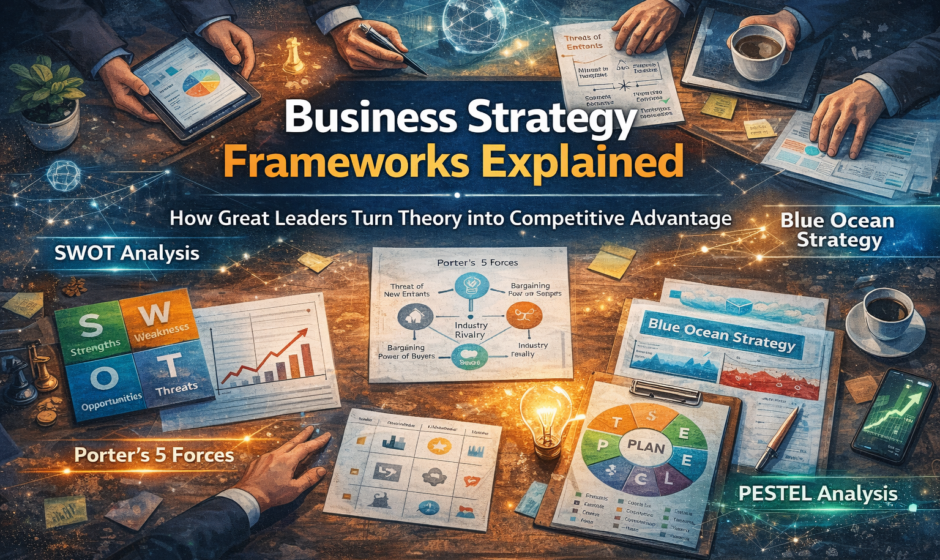
- Use SWOT analysis to identify internal and external factors
- Apply PESTLE to understand macro trends
- Leverage Blue Ocean Strategy to identify new market opportunities
Real Example:
Tesla’s strategy cannot be explained by a single framework. It combines vertical integration, innovation strategy, and ecosystem thinking to disrupt multiple industries simultaneously.
Key Insight:
The power of frameworks lies in their integration, not their isolation.
Actionable Lessons:
- Layer frameworks to analyze problems from different angles
- Encourage cross-functional teams to contribute diverse perspectives
- Avoid over-reliance on a single strategic lens
4. Execution Is the Ultimate Differentiator
A brilliant strategy poorly executed is indistinguishable from a bad strategy.
Frameworks often focus on analysis—but leadership must focus on execution.
Data Point:
Harvard Business Review research suggests that execution effectiveness is twice as important as strategy quality in driving performance.
Real Example:
Amazon’s success is not just about strategic positioning—it is about relentless execution. From logistics to customer experience, the company translates strategy into operational excellence.
Key Insight:
Strategy without execution is merely aspiration.
Actionable Lessons:
- Align incentives with strategic priorities
- Break down strategy into measurable objectives
- Build feedback loops to track execution in real time
5. Strategy Must Be Human-Centric
Most frameworks focus on markets, competitors, and resources. Few adequately address the human element.
Yet, strategy ultimately depends on people—employees, customers, and leaders.
Trend Insight:
Organizations with strong cultures outperform peers by up to 20–30% in long-term performance metrics.
Real Example:
Companies like Southwest Airlines have built strategies around employee engagement and customer experience, creating differentiation that competitors struggle to replicate.
Key Insight:
Culture is not separate from strategy—it is a core component of it.
Actionable Lessons:
- Embed cultural considerations into strategic planning
- Align leadership behavior with strategic goals
- Measure employee engagement as a strategic KPI
Case Studies: Strategy Frameworks in Action
Case Study 1: Netflix and Disruptive Strategy
Netflix’s evolution from DVD rentals to streaming is a textbook example of disruptive innovation.
By applying elements of Blue Ocean Strategy, Netflix created a new market space rather than competing directly with traditional broadcasters.
Impact:
- Over 230 million global subscribers
- Redefined content consumption worldwide
Lesson:
The most powerful strategies often redefine the rules of competition.
Case Study 2: IKEA and Cost Leadership
IKEA’s strategy is rooted in cost leadership combined with differentiated design.
By rethinking the value chain—flat-pack furniture, self-service warehouses—the company reduces costs while maintaining customer appeal.
Impact:
- Global presence in over 50 countries
- Strong brand loyalty
Lesson:
Competitive advantage often lies in reimagining operational models.
Case Study 3: Google and Ecosystem Strategy
Google’s strategy extends beyond search into a broader ecosystem of products and services.
This creates network effects—each product strengthens the others.
Impact:
- Dominance in digital advertising
- Expansion into AI, cloud computing, and hardware
Lesson:
Ecosystems create defensible competitive advantages in the digital age.
Future Implications: The Evolution of Strategy Frameworks
The next generation of strategy frameworks will look very different from today’s models.
1. AI-Driven Strategy
Artificial intelligence will enable real-time strategic analysis, shifting frameworks from static tools to dynamic systems.
2. Continuous Strategy
Annual strategy cycles will be replaced by continuous strategy processes.
3. Decentralized Decision-Making
Frameworks will be used across organizations, not just at the executive level.
4. Sustainability as Strategy
Environmental and social considerations will become core strategic drivers, not peripheral concerns.
Critical Insight:
The future of strategy is not about better frameworks—it is about better thinking.
Conclusion: From Frameworks to Judgment
Business strategy frameworks are indispensable—but insufficient.
They provide structure, but not certainty. Insight, but not action.
The CEOs who excel are those who move beyond frameworks to judgment—combining analysis with intuition, data with experience, and strategy with execution.
Key Takeaway:
Frameworks don’t create competitive advantage. Leaders do—by using them wisely, adapting them constantly, and acting on them decisively.
FAQs
1. What is the most important business strategy framework?
There is no single “most important” framework. The best leaders use multiple frameworks depending on the context.
2. How do CEOs choose the right framework?
By understanding the problem they are trying to solve and selecting frameworks that provide relevant insights.
3. Why do many strategies fail?
Most failures are due to poor execution, lack of alignment, and inability to adapt to change.
4. Can small businesses use strategy frameworks?
Absolutely. Frameworks are scalable and can help businesses of all sizes make better decisions.
5. How often should strategy be reviewed?
In today’s environment, strategy should be continuously monitored and adjusted rather than reviewed annually.