
Introduction
The mythology of the CEO as a singular visionary—charismatic, decisive, and omniscient—is rapidly dissolving. In its place emerges a more complex reality: leadership today is less about authority and more about adaptability, systems thinking, and emotional intelligence at scale. The modern CEO is not merely a decision-maker but an orchestrator of uncertainty.
In an era defined by AI disruption, geopolitical volatility, and shifting workforce expectations, leadership has become a dynamic capability rather than a static trait. The CEOs who thrive are not those with the loudest voices, but those with the deepest awareness—of markets, people, and themselves.
This article argues that the leadership mandate has fundamentally changed. And with it, the skills required to lead at the highest level.
Why This Topic Matters Today
The pace of change is no longer linear—it is exponential.
- According to McKinsey, over 70% of executives say their organizations face disruption at an unprecedented scale.
- A Deloitte survey found that only 23% of leaders feel prepared to manage future workforce challenges.
- Meanwhile, the rise of generative AI is expected to impact over 300 million jobs globally.
These are not incremental shifts. They are systemic transformations.
The implication is clear: traditional leadership models—command-and-control, intuition-led decision-making, hierarchical authority—are insufficient. CEOs today must navigate ambiguity, inspire distributed teams, and make high-stakes decisions with incomplete information.
Leadership is no longer about knowing the answers. It is about asking better questions—and building organizations that can answer them.
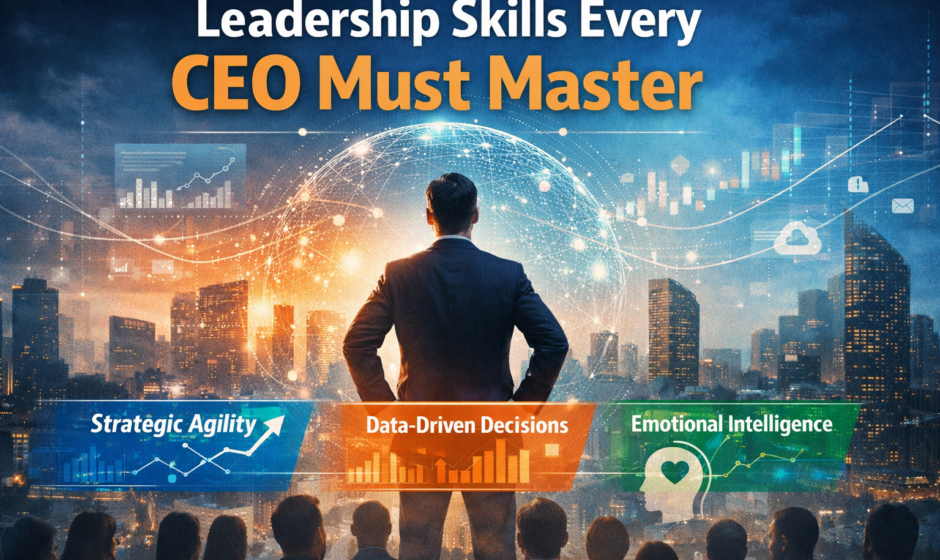
Key Leadership Skills Every CEO Must Master
1. Strategic Agility: Leading Through Uncertainty
The ability to pivot—without losing direction—is perhaps the most critical CEO skill today.
Strategic agility is not reactive; it is anticipatory. It requires CEOs to continuously reassess assumptions, reallocate resources, and redefine priorities.
Real Example:
During the COVID-19 pandemic, Microsoft rapidly shifted its focus toward cloud infrastructure and remote collaboration tools. This strategic pivot was not accidental—it was rooted in years of investment in Azure and a clear understanding of digital transformation trends.
Key Insight:
Agile leaders don’t wait for disruption—they prepare for it.
Actionable Lessons:
- Build scenario planning into quarterly strategy reviews
- Encourage dissenting viewpoints in executive discussions
- Allocate “flex capital” for rapid experimentation
2. Data-Driven Decision Making: From Intuition to Intelligence
Gut instinct has its place—but in a data-rich world, it must be complemented by analytical rigor.
CEOs today must be fluent in data—not as analysts, but as interpreters. The ability to translate data into strategic insight is a defining leadership advantage.
Real Example:
Amazon’s leadership culture is deeply rooted in metrics. From customer behavior to operational efficiency, decisions are grounded in data narratives rather than opinions.
Key Insight:
Data does not replace judgment—it sharpens it.
Actionable Lessons:
- Establish a single source of truth for organizational data
- Promote “data storytelling” across leadership teams
- Invest in AI-driven analytics for predictive decision-making
3. Emotional Intelligence at Scale: Leading Humans, Not Just Organizations
As automation rises, human leadership becomes more—not less—important.
Emotional intelligence (EQ) is no longer a “soft skill.” It is a core leadership competency that influences culture, engagement, and performance.
Data Point:
Research by TalentSmart shows that EQ accounts for 58% of job performance across roles.
Real Example:
During periods of internal restructuring, companies like Airbnb prioritized transparent communication and employee empathy—resulting in stronger brand loyalty and internal trust.
Key Insight:
Employees don’t leave companies—they leave leadership.
Actionable Lessons:
- Conduct regular “listening sessions” with employees
- Train leadership teams in empathy and conflict resolution
- Measure employee sentiment as rigorously as financial metrics
4. Talent Architecture: Building Future-Ready Organizations
The CEO’s role is not to solve every problem—but to build teams that can.
This requires a shift from talent management to talent architecture: designing systems that attract, develop, and retain high-performing individuals.
Trend Insight:
The rise of hybrid work has redefined talent pools. CEOs now compete globally for skills, not locally for employees.
Real Example:
Companies like Google have invested heavily in learning ecosystems, enabling employees to continuously reskill in areas like AI, cloud computing, and product innovation.
Key Insight:
Your organization’s capability is a direct reflection of its talent strategy.
Actionable Lessons:
- Prioritize skills over roles in hiring decisions
- Create internal mobility programs to retain talent
- Invest in continuous learning platforms
5. Purpose-Driven Leadership: Aligning Profit with Impact
Today’s stakeholders—employees, customers, and investors—expect more than financial performance. They demand purpose.
Purpose-driven leadership is not about slogans—it is about alignment between values and actions.
Data Point:
A PwC study found that 79% of business leaders believe purpose is central to success, yet only 34% say their company’s purpose is consistently applied.
Real Example:
Patagonia’s commitment to environmental sustainability has not only strengthened its brand but also driven long-term profitability.
Key Insight:
Purpose is a competitive advantage—when it is authentic.
Actionable Lessons:
- Define a clear organizational purpose beyond profit
- Integrate purpose into strategic decision-making
- Hold leadership accountable for purpose-driven outcomes
Case Studies: Leadership in Action
Case Study 1: Satya Nadella and Cultural Transformation
When Satya Nadella became CEO of Microsoft, the company was seen as bureaucratic and stagnant.
His leadership focused on a cultural shift—from “know-it-all” to “learn-it-all.”
Impact:
- Microsoft’s market value increased from ~$300 billion in 2014 to over $2 trillion
- Employee engagement scores improved significantly
Lesson:
Culture is not a byproduct of leadership—it is its primary output.
Case Study 2: Elon Musk and Vision-Driven Execution
Elon Musk’s leadership at Tesla and SpaceX is defined by bold vision and relentless execution.
While controversial, his approach demonstrates the power of ambitious goal-setting.
Impact:
- Tesla became the world’s most valuable automaker
- SpaceX revolutionized private space exploration
Lesson:
Vision attracts talent—but execution sustains it.
Case Study 3: Indra Nooyi and Purpose-Led Strategy
As CEO of PepsiCo, Indra Nooyi introduced the “Performance with Purpose” strategy—aligning business growth with health and sustainability.
Impact:
- Strong revenue growth
- Improved brand perception globally
Lesson:
Long-term value creation requires integrating purpose into core strategy.
Future Implications: The Next Evolution of CEO Leadership
The CEO of the future will look fundamentally different from the CEO of the past.
1. AI-Augmented Leadership
Leaders will increasingly rely on AI for decision support, requiring a new form of digital literacy.
2. Decentralized Organizations
Hierarchies will flatten, and decision-making will become more distributed.
3. Continuous Reinvention
Static strategies will give way to dynamic, evolving business models.
4. Stakeholder Capitalism
Success will be measured not just by shareholder returns, but by societal impact.
Critical Insight:
The future CEO is not defined by control—but by adaptability.
Conclusion: The New Leadership Imperative
Leadership is no longer a position—it is a practice.
The CEOs who will define the next decade are those who can navigate complexity with clarity, lead people with empathy, and make decisions with both data and conviction.
The question is no longer: What does a CEO do?
The question is: What kind of leader must a CEO become?
Key Takeaway:
The most effective CEOs are not the ones who have all the answers—but the ones who build organizations capable of finding them.
FAQs
1. What is the most important leadership skill for CEOs today?
Strategic agility is arguably the most critical, as it enables leaders to navigate uncertainty and adapt quickly to change.
2. How can CEOs improve emotional intelligence?
Through active listening, feedback mechanisms, leadership coaching, and regular employee engagement initiatives.
3. Why is data-driven decision-making important for CEOs?
It reduces bias, improves accuracy, and enables predictive insights that drive better strategic outcomes.
4. What role does purpose play in leadership?
Purpose aligns stakeholders, enhances brand loyalty, and drives long-term value creation.
5. How can CEOs build future-ready organizations?
By investing in talent development, embracing technology, and fostering a culture of continuous learning.